

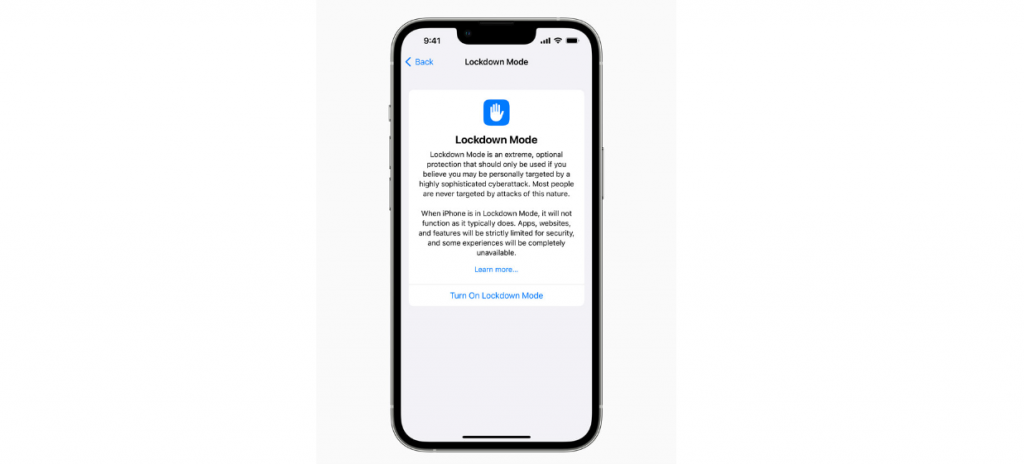
Credit: Apple
Small businesses may be the primary targets of cyberattacks, but more sophisticated hacking and surveillance exploits center on not just large corporations but also the powerful and influential members of society. These are the CEOs, CFOs, other corporate executives, political leaders, dissidents, and journalists. They make up a tiny percentage of society, thus the solutions of cybersecurity developers are more geared toward protecting their organization than affording them personal security. This was largely the case until one of the world’s biggest mobile providers stepped in.
Apple recently announced a new mobile security feature that specifically protects users who are potentially at risk of attacks like state-sponsored mercenary spyware and sophisticated hacking procedures. To be released with iOS 16 and macOS Ventura, Lockdown Mode places a host of restrictions on a mobile device, disabling services and protocols that would likely serve as entry points for hackers and spyware. Think of it as Safe Mode but oriented to stop cyberattacks instead of troubleshooting software issues.
Lockdown Mode’s Safety Restrictions
When activated, Lockdown Mode offers protection features in the following areas:
- Internet browsing: Lockdown Mode disables complex scripts, like just-in-time (JIT) JavaScript compilation, often exploited by spyware and hackers.
- Instant messaging: Except for images, all kinds of attachments are not permitted. The restriction is extended to link previews.
- Hardware connections: Lockdown Mode bars a mobile device from recognizing wired connections to desktops and accessories.
- User profiles: Lockdown Mode prevents the creation of online profiles, including those for work and school. It also blocks enrollments in mobile device management systems.
- Apple services: Lockdown Mode enables users to only interact with confirmed connections. It blocks incoming service requests and invitations, including FaceTime calls, from parties whom the user has never interacted with.
Apple aims to add more security features to Lockdown Mode over time and plans to collaborate with the security research community. The company offers a bounty of up to $2 million to researchers who find security bypasses in its Lockdown Mode. In addition, it is extending a grant of $10,000 to aid organizations that investigate and expose cyberattacks and their sources.
Ideal Complement to Corporate Security
Apple’s Lockdown Mode adds several layers of individual protection to the ones afforded by IT and network security platforms. As a result, organizations receive enhanced security for cyberattacks and data breaches. Data breaches come as an immediate concern. Recent statistics reveal that the number of US breaches increased by 14% in the first quarter of 2022, year-over-year. Lockdown Mode is instrumental in stopping these since over 90% of breaches stem from cyberattacks.
SaaS developers would likely find inspiration in Apple’s Lockdown Mode and assimilate its functionalities into their platforms, perhaps making it available for desktops. However, instead of limiting the scope to high-value targets, SaaS solutions can expand the solutions to make them relevant to all enrolled individuals in an organization. After all, mercenary spyware, hackers, and other types of malware can target individuals to gain access to corporate networks. These attacks may take place away from the office, outside working hours.
Mobile SaaS solutions can also build on the areas that the Lockdown Mode has yet to restrict. These include phone cameras, GPS, and built-in microphones. Moreover, mobile device management platforms can integrate and innovate on these security features to ensure holistic protection.
In any case, Apple’s Lockdown Mode has opened the door to improved individual security. It has imposed a new standard on mobile security measures and other mobile OS providers like Google would likely follow suit.











 Why is FinancesOnline free?
Leave a comment!