

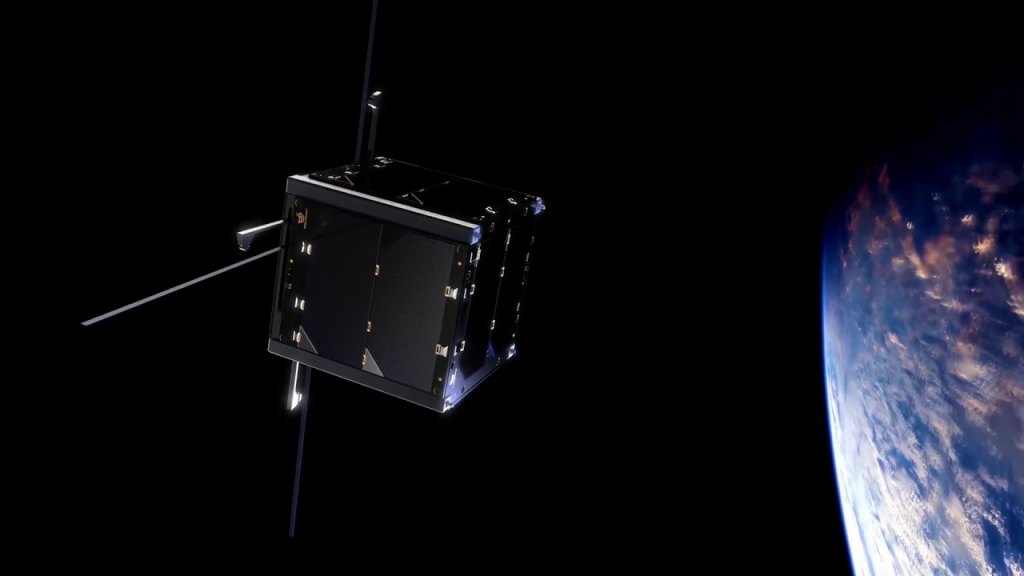
Credit: EnduroSat
Space services provider EnduroSat launches its nanosatellite today at 2:25 PM ET for its second mission. What makes this venture exciting for visionary entrepreneurs and technologists is that the company is bringing along space edge computing and cloud technologies from IBM and Red Hat. The mission’s objective is to provide developers with easy access to space data, potentially driving innovation in various sectors. IBM also aims to stimulate the interest of school children in outer space through technology. And painless access to space data makes this possible.
The software powering EnduroSat’s nanosatellite integrates with IBM’s edge computing solution for space, which runs on a hybrid cloud environment from IBM and Red Hat. This setup enables developers to manage and push code from their devices that ultimately reaches and is processed by the nanosatellite’s various sensors. As such, the satellite can take photos, calculate data, and then send the results back to users.
“This work to help democratize access to space will help further accelerate space exploration and innovation,” Nareem Altaf, IBM engineer and CTO for Space Technology, said. “We are excited to see the rapid data services deployment and the innovations that our partners are unleashing in orbit,” Raycho Raychev, CEO of EnduroSat, added.
There is plenty to be excited about indeed, considering that, according to a 2022 Citi report, the annual revenue of the space industry is projected to reach $1 trillion by 2040. And improved access to space data can embolden entrepreneurs and innovators to turn to outer space for business opportunities. This also opens up a future in space entrepreneurship for students who develop an interest in space-related solutions.
Monetizing Space Activities
Although living, much less purchasing goods, on the nearest habitable planet continues to be a pipedream, there are still plenty of business opportunities related to outer space. In 2021, there were 134 launches of humans and satellites into outer space, the highest number in history. And plans for 2022 intend to break that record, as space companies and agencies aim for 200 orbital launches. The EnduroSat and IBM collaboration could speed up preparations for such and further increase the number of human and satellite launches in succeeding years. These space expeditions present a host of opportunities for tech entrepreneurs.
Producing Spacecraft Computing Solutions
Tech developers can leverage data from the EnduroSat nanosatellite to produce onboard computing solutions for spacecraft. Looking at the latest cloud computing statistics, the market size of space computing platforms is expected to reach $1.3 billion this year and eventually hit $2.3 billion by 2027, at an annual growth rate of 12.1%. Besides the aforementioned increase in orbital launches, the rising popularity of small satellites and the growing number of space initiatives from private companies drive the growth of the market.
Developing Satellite and Spacecraft Sustainability Solutions
There is a high demand for satellite and spacecraft sustainability solutions, from improving and expanding the functionalities of satellites to clearing space debris. And data from the EnduroSat nanosatellite can give budding space investors an idea about the conditions in outer space and what solutions to develop given those conditions. These can improve the data collection of satellites and extend their useful lives.
Space Mining
With the EnduroSat providing images and calculations, technologists and entrepreneurs can develop equipment for mining gases and minerals in outer space or environments like the moon, Mars, and asteroids. The discovery of rare materials for research could lead to significant profits, especially when taken in large amounts. In fact, a lot of valuable asteroids have already been discovered. As such, the market value of space mining is expected to rise from $947 million in 2020 to $4.2 billion by 2030, growing annually by 19.98%.
Satellite Weather Prediction Services
Weather stations rely on satellites to predict weather conditions. The current setup sees a 90% accuracy for five-day forecasts, 80% for seven-day forecasts, and 50% for 10-day ones. Although this is sufficient to evacuate some communities in the event of a storm, drawn-out storm surges can leave a lot of people stranded or in danger. The EnduroSat’s, or a similar satellite in the future’s, capabilities potentially clear up roadblocks to reported data, thus raising the accuracy of weather forecasts for longer periods.
Space Collaboration Tools
With the flow of data now unimpeded, thanks to the model leveraged by IBM, EnduroSat, and Red Hat, tech developers can create cloud-based collaboration tools for space organizations and astronauts or space travelers using EnduroSat’s nanosatellite. If this is not possible, software solutions can be developed using a model similar to the one leveraged by IBM, EnduroSat, and Red Hat. In this way, people in space can transmit crystal clear images and accurate findings from where they are in the galaxy.
This is but the tip of a universe-sized iceberg of opportunities. As technology continues to evolve, more can be gleaned in the not-so-distant future.













 Why is FinancesOnline free?
Leave a comment!